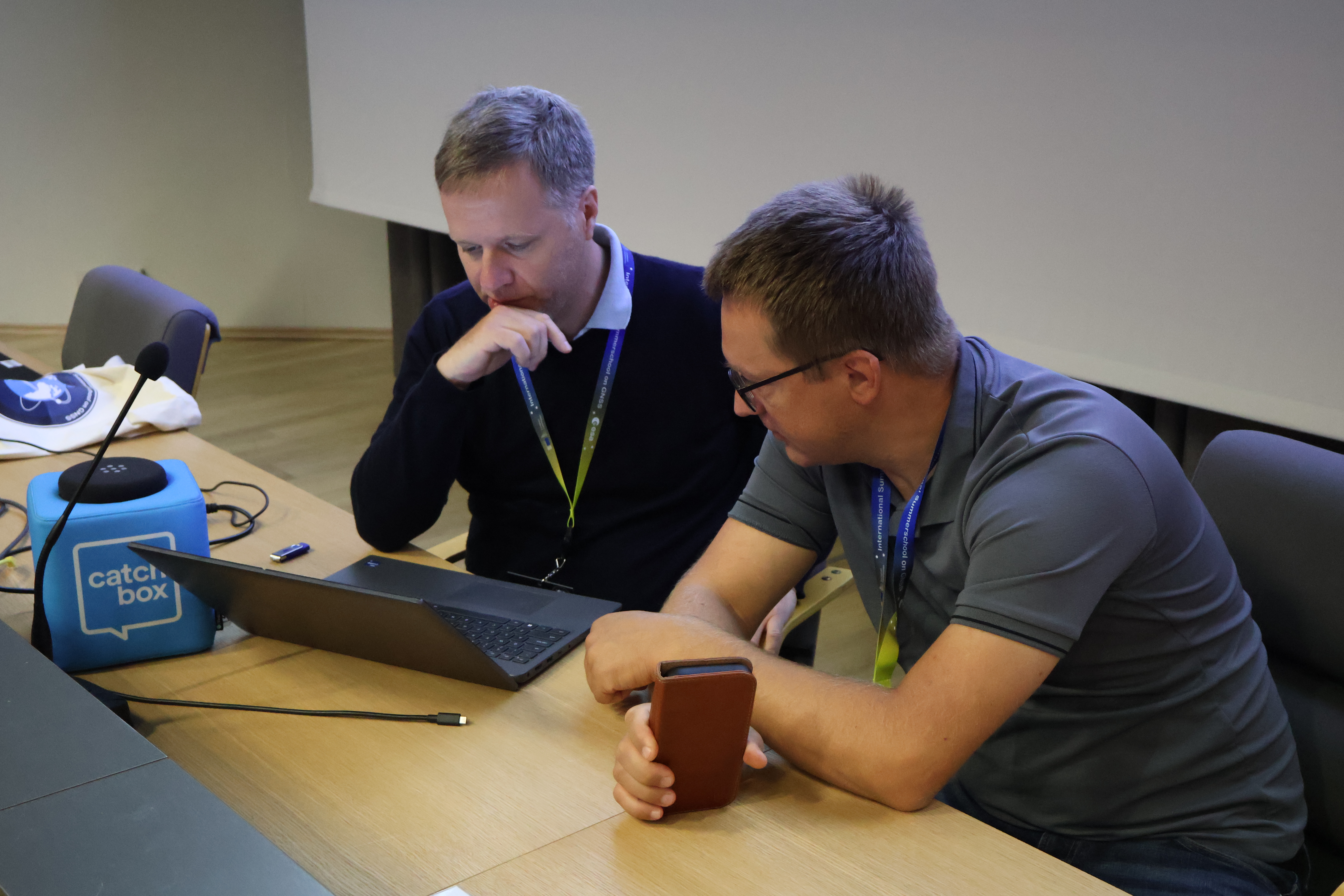
From July 13 to 24, the ESA/JRC International Summer School on GNSS 2026, organised by the European Space Agency (ESA) and the European Commission's Joint Research Centre (JRC), took place in Espoo (Finland). The Summer school was also attended by Agris Zimelis, Researcher and Doctor of Forest Sciences of LSFRI 'Silava', who is further developing his expertise as part of the postdoctoral research project Sensor system for automated detection and monitoring of soil rutting caused by forest machinery.
Over the course of two weeks, participants learned about the principles of operation of Global Navigation Satellite Systems (GNSS), GNSS signals and receivers, data processing, and precise positioning techniques, including RTK (Real-Time Kinematic) and Precise Point Positioning (PPP). During practical sessions, participants carried out GNSS measurements and assessed the quality of the data obtained. The programme also covered the Galileo system, positioning reliability, GNSS signal interference and cybersecurity.
At the end of the Summer school, participants worked in international teams to develop proposals for the use of GNSS technologies and presented them to experts. This experience provided an opportunity to enhance not only technical knowledge but also skills in research development, teamwork and the presentation of research results.
The knowledge gained will be valuable for research of LSFRI 'Silava' on the movement of forest machinery, where accurate determination of machinery location and direction of movement is required. The acquired expertise will contribute to the further development of solutions involving an RTK base station, dual GNSS antennas and GNSS data quality assessment for forestry research.
Participation in the Summer school also provided an opportunity to establish professional contacts with representatives of ESA, JRC, universities and technology companies, creating opportunities for future international cooperation on the use of GNSS technologies in forestry.